
FAQ: Keeping Our Community Informed
Lake Forest School Districts 67 & 115
2026–2027 Frequently
Asked Questions
Answers to common questions from our school families and community members. This is not an exhaustive compilation of school information. Rather, this is a tool for timely sharing in response to current community questions. We update this page as new questions arise or information changes.
District 67 (Pre-K–8) and District 115 (Lake Forest Community High School) · Last updated October 16, 2026
Top of Mind
Recent questions from our school community
2 questions
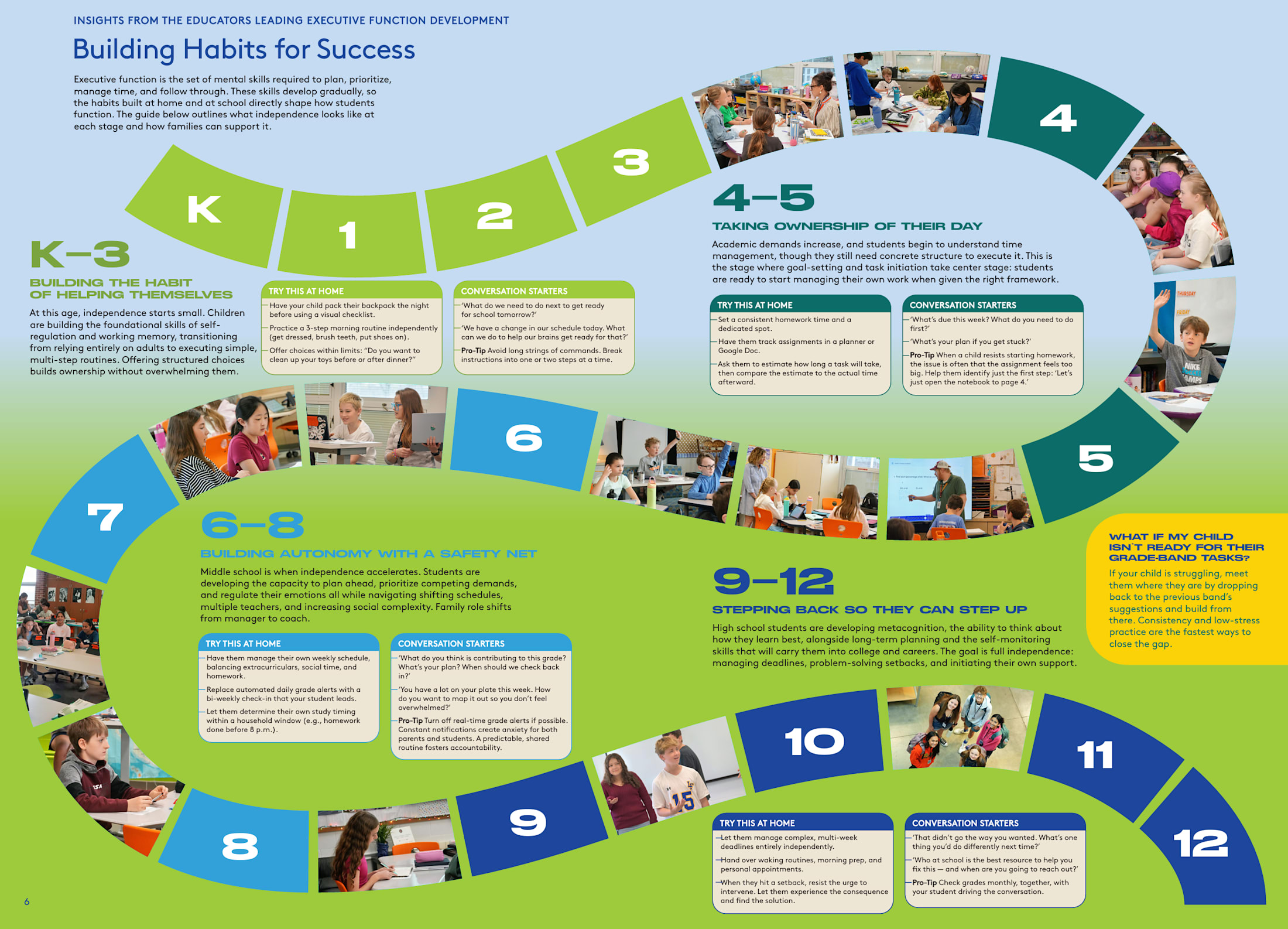
I'm hearing a lot about executive function. What is it and how can it help support my child in building successful habits at school and home?
Executive function is the set of mental skills required to plan, prioritize, manage time, and follow through. These skills develop gradually, so the habits built at home and at school directly shape how students function. The guide below outlines what independence looks like at each stage and how families can support it.
What are Shared Services and how do they benefit our community?
Two districts, one coordinated approach
Since 2004, Lake Forest School Districts 67 and 115 have operated under a Shared Services Agreement designed to strengthen services for students and families while using community resources responsibly. The model allows the districts to share specialized personnel, expertise, systems, and operational support while each district remains independently governed by its own Board of Education.
Shared Services Between the Districts (as of July 1, 2026)
| Category | Details as of July 2026 |
|---|---|
| Shared FTE positions | 36.5 |
| Functions covered | Business services, facilities, communications, HR, safety and security, special education, superintendent's office, technology, teaching and learning |
| Additional FTE needed if operated separately | 10.5 |
| Additional annual personnel cost if separate | ~$1.9 million |
| Additional cost over five years if separate | More than $9.5 million |
A shared structure helps Districts 67 and 115:
- Access specialized expertise across both organizations
- Reduce unnecessary duplication of positions and systems
- Direct more available resources toward classrooms and students
- Leverage greater economies of scale for contracts and services
- Coordinate student support, technology, safety, and learning
Learn more in the Lake Forest Schools Shared Services Report.
District 67
Pre-K–8 at Cherokee, Everett, and Sheridan Elementary Schools, and Deer Path Middle School
6 questions
How are District 67 students performing?
Among the highest in Illinois, and every District 67 school has earned the state's top designation of "Exemplary".
Among non-selective elementary districts, D67 ranks in the 98th percentile for math and 96th for English language arts. On the Illinois Assessment of Readiness, about 89.6% of eighth graders were proficient in ELA and 82.8% in math. Eighth-grade results grew significantly from 2022 to 2025: ELA rose from the 38th to the 94th percentile and math from the 81st to the 99th.
No single statistic captures the student experience, so the district also considers growth, attendance, engagement, belonging, and skill development. These results are from the 2025 Illinois State Report Card; the 2026 report card is due October 30, 2026, and this page will be updated.
Learn more: District 67 2025 ISBE Report Card
What's the typical District 67 class size?
Average class sizes range from 16.3 (8th grade) to 21.0 (3rd grade).
The student-to-teacher ratio is 12:1, which is calculated according to a state-mandated formula. As a result, this ratio differs from class size and includes teachers whose work may not correspond to one traditional classroom section. Individual classes may be larger or smaller. Sizes vary with uneven enrollment, and administrators weigh instructional needs, specialized programs, staffing, schedules, facilities, and budget when determining class size.
How is student learning measured and shared with families?
With many measures, not one test.
Teachers use observations, projects, quizzes, and unit assessments. D67 adds universal screening and progress monitoring through its Multi-Tiered System of Supports (MTSS), plus state tests. Families receive updates through teacher feedback, conferences, report cards, Schoology, and PowerSchool.
At this time, you will find the following assessment reports posted to your secure account in our PowerSchool Parent Portal:
- Measures of Academic Progress (MAP)
We administered this assessment in September to all 2nd-8th grade students. MAP is a Common Core-aligned, adaptive, computer-based assessment. This nationally normed assessment measures growth over time in reading and math. The MAP uses a RIT (Rausch Unit) scale developed to simplify the interpretation of test scores as it grows over time. The district uses MAP achievement and growth data to inform instructional planning for individuals and groups of students and to measure year-to-year growth. Here is a family guide to further understanding of the NWEA MAP assessment. - Illinois Assessment for Readiness (IAR) & Illinois Science Assessment (ISA)
Both the IAR and ISA are administered in the spring, and the Illinois State Board of Education (ISBE) shares final reports with school districts each fall. The IAR is administered to students in third through eighth grades, and measures students’ progress toward meeting the Common Core State Standards in both English language arts and mathematics. The ISA is administered to fifth- and eighth-grade students and measures students’ progress toward meeting the Next Generation Science Standards (NGSS). Only students who participated in these state assessments last spring receive score reports. ISBE also released a Family Fact Sheet detailing adjustments to the IAR and ISA performance levels beginning in 2025.
What if my child needs more challenge or more support?
Start with your child's teacher and describe what you are seeing.
More challenge: District 67 offers differentiated instruction, enrichment and acceleration, an advanced math sequence, and an identification process.
More support: MTSS provides universal, targeted, and intensive support. If you think your child may need services or a formal evaluation, you may also contact the principal or school psychologist. The school may review information and adjust supports, and you may ask the district to consider an evaluation. A student without an IEP may still qualify for accommodations under Section 504. The school team will explain next steps, notices, and your rights.
Learn more: District 67 MTSS and Student Services | District 67 Section 504
How can I raise a concern about instruction or my child's experience?
Start with the person closest to the issue, usually the teacher, then the principal.
You may inspect instructional materials. Send requests to inspect materials or seek an exemption or opt-out to the principal, or submit general questions through Let's Talk. Individual student and personnel matters are handled privately, so they generally can't be resolved through Board public comment.
Learn more: D67 curriculum inquiries
How are snow days and other weather closures handled?
The safety of our students and staff guides every decision about closing school, delaying the start of the day, or moving to eLearning.
District 67 does not have a built-in (traditional) emergency day in the 2026-2027 school year. This means:
- The first day school is closed due to weather or another emergency will be an eLearning day.
- There will be no traditional “snow day” without instruction this school year.
By Illinois state law, District 67 has still designated five emergency days at the end of the school year, if needed.
Decisions about school closures or schedule changes will continue to be made based on multiple factors, including weather forecasts, road conditions, transportation, and consultation with local agencies and neighboring districts.
If a closure or schedule change occurs, families will be notified via the BrightArrow system, including by phone, email, and text. More information about School and Emergency Closings can be found on our website.
District 115
Grades 9–12 at Lake Forest Community High School (LFHS)
9 questions
How are LFHS students performing?
Among the highest in Illinois.
Among non-selective high school districts, District 115 ranks in the 99th percentile for average ACT, #4 in ACT math and #5 in ACT English language arts. About 601 students take AP exams, and 94% score 3 or higher. LFHS has 106 Illinois State Scholars, and the Class of 2027 includes 10 National Merit Semifinalists.
For the second time, Chicago Magazine named LFHS the top public high school in Lake County, measuring academic proficiency and growth, attendance, and graduation rates. Rankings and test scores offer one perspective, not the full picture; the district also considers growth, attendance, engagement, belonging, and skill development. These results are from the 2025 Illinois State Report Card; the 2026 report card is due October 30, 2026, and this page will be updated.
Learn more: District 115 2025 ISBE Report Card
What does "college and career readiness" mean at LFHS, and does every student need Advanced Placement (AP) courses?
It goes beyond college admission, and no, not every student needs to take AP courses. Success looks different for every student.
Students build academic knowledge along with critical thinking, communication, adaptability, collaboration, and confidence. LFHS offers multiple pathways and levels of challenge so each student can choose courses that fit their interests, goals, and readiness. The Class of 2025 attended 132 different colleges and universities, and LFHS has a 98% graduation rate.
How does LFHS help students feel they belong?
Largely through activities: about 95.7% of students are engaged in at least one of 98 clubs, activities, and athletic options.
The 2025–2026 club list spans advocacy, competitive teams, creative and social clubs, leadership, music and theater, publications, service, world cultures, and political and religious groups. Athletics, arts, clubs, service, and leadership groups help students build relationships and feel connected. In 2025–2026, students completed more than 7,430 community service hours.
What are the Scout Standards?
The Scout Standards are the Lake Forest High School Athletics Department's commitment to excellence for student-athletes and coaches: six expectations, one for each letter of SCOUTS.
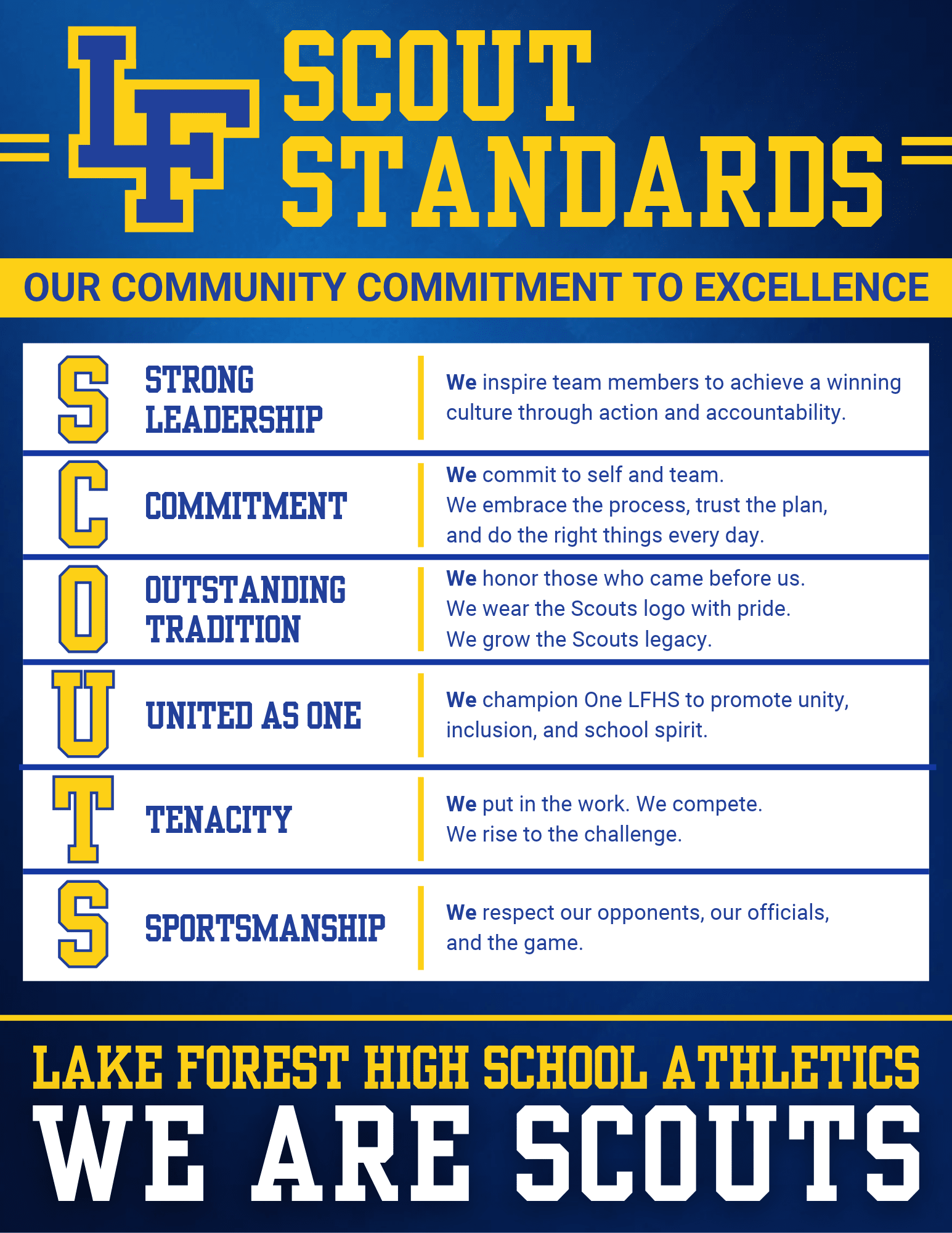
The standards set a shared expectation for how Scouts athletes, coaches, and fans compete, lead, and represent Lake Forest High School, on and off the field.
What's the typical class size?
Grade-level averages range from 12.8 (11th grade) to 15.8 (12th grade).
The student-to-teacher ratio is 13:1, which is calculated according to a state-mandated formula. As a result, this ratio differs from class size and includes teachers whose work may not correspond to one traditional classroom section. Individual classes may be larger or smaller. Sizes vary with enrollment and student course requests, and administrators weigh instructional needs, specialized programs, staffing, schedules, facilities, and budget when determining class size.
How is learning measured, and how does student voice shape it?
With many measures, not one test, and with regular input from students.
Teachers use observations, projects, quizzes, and unit assessments. LFHS also looks at course performance, AP and ACT results, ninth-grade-on-track, and graduation data. Families receive updates through teacher feedback, conferences, report cards, Schoology, and PowerSchool.
Student feedback helps refine programs. For example, feedback on LFHS Scout Seminar led to 2026–2027 changes: shorter, more active sessions, protected work time, responsible AI learning, and earlier college and career planning.
What if my student needs more challenge or more support?
Start with the classroom teacher or your student's counselor.
More challenge: LFHS offers College Prep, Honors, and AP courses, independent study, and seminars. Review the Student Course Guide and talk with a counselor.
More support: Help may come through Personal Learning Time, before- and after-school help, department resource centers, or a counselor, dean, social worker, or psychologist. Options can include study hall, peer tutoring, executive-function tutoring, and daily check-ins. If you think your student may need services or a formal evaluation, contact the counselor or Student Services team. You may ask the district to consider an evaluation, and a student without an IEP may still qualify for accommodations under Section 504. The school team will explain next steps, notices, and your rights.
Learn more: LFHS academic support | District 115 special education
How can I raise a concern about instruction or my student's experience?
Students are encouraged to speak up first, starting with the person closest to the issue, usually the teacher.
Before a parent/guardian shares a concern with the school, students are encouraged to first speak with a teacher, counselor, or instructional director and/or Student Council. Families may inspect instructional materials. Individual student and personnel matters are handled privately, so they generally can't be resolved through Board public comment.
Learn more: D115 Core Teams
How are snow days and other weather closures handled?
The safety of our students and staff guides every decision about closing school, delaying the start of the day, or moving to eLearning.
District 115 has one built-in emergency day scheduled for April 23, 2027. This means:
- April 23, 2027, is reserved as a potential make-up day for emergency school closure. If the District needs to use an emergency closure day during the school year, school will be in session on April 23, 2027. If not, there will be no school that day.
- If additional emergency days are needed, they will be made up through eLearning, as outlined on our website.
- The district also has four additional emergency days built into the end of the school calendar, as required by the state.
As always, decisions to close or adjust the school day are made carefully using a variety of information sources, including weather reports, local conditions, transportation updates, and coordination with other districts.
If a closure or schedule change occurs, families will be notified via the BrightArrow system, including by phone, email, and text. More information about School and Emergency Closings can be found on our website.
Budget, Staffing, and Taxes
How the districts manage people and money
6 questions
95.3%D67 revenue from local sources
96.6%D115 revenue from local sources
Aaa / AAABond ratings (Moody's / S&P)
Where does school funding come from, and how do our tax rates compare?
Mostly local revenue, and Lake Forest's tax rates are the lowest among the benchmarks shown.
About 95.3% of D67 and 96.6% of D115 revenue is local: property taxes plus investment earnings, tuition, food service, facility rentals, fees, and more. State and federal funding are a small share.
| Lake County comparison | Lake Forest | Next lowest | Highest |
|---|---|---|---|
| District 67 (8 elementary districts) | 1.556 | 1.846 (Rondout SD 72) | 3.630 (Hawthorn CCSD 73) |
| District 115 (10 high school districts) | 1.602 | 1.888 (Grant CHSD 124) | 3.168 (Grayslake CHSD 127) |
Has staffing increased, and how many administrators are employed?
No. Total staffing is lower in both districts than in 2022–2023. District 67 has 15.0 FTE administrators; District 115 has 18.9.
| District 67 staff (FTE) | 22–23 | 23–24 | 24–25 | 25–26 | 26–27 |
|---|---|---|---|---|---|
| Admin | 16.00 | 16.50 | 15.50 | 14.50 | 15.00 |
| Ed support | 38.25 | 40.75 | 38.75 | 38.75 | 40.24 |
| Teachers | 218.13 | 218.75 | 213.32 | 211.37 | 209.75 |
| Teaching assistants | 59.32 | 59.57 | 61.41 | 60.01 | 61.51 |
| Contracted hires | 5.00 | 6.00 | 6.00 | 2.00 | 0 |
| Total | 336.70 | 341.60 | 334.98 | 326.63 | 326.5 |
District 67 fell from 336.70 to 326.5 FTE (down 10.2), including teachers (218.13 to 209.75), contracted hires (5 to 0), and administrators (16.0 to 15.0). Teaching assistants (59.32 to 61.51) and ed support (38.25 to 40.24) rose slightly. D67 peaked at 341.60 in 2023–24. Administrators (principals, assistant principals, instructional directors) have ranged from 14.5 to 16.5 in recent years.
| District 115 staff (FTE) | 22–23 | 23–24 | 24–25 | 25–26 | 26–27 |
|---|---|---|---|---|---|
| Admin | 18.20 | 18.20 | 18.40 | 18.40 | 18.90 |
| Teachers | 156.70 | 149.90 | 152.40 | 151.30 | 147.80 |
| TAs / ESPs | 141.46 | 139.13 | 137.30 | 134.43 | 134.23 |
| Total | 316.36 | 307.23 | 308.10 | 304.13 | 300.93 |
District 115 fell from 316.36 to 300.93 FTE (down 15.43), with teachers down 8.9 and TAs/ESPs down 7.23. Administrators have been essentially flat; the rise from 18.4 to 18.9 FTE is a temporary 0.5 FTE co-athletic director overlap expected to end after a retirement next year.
Meanwhile, 36.5 positions are shared across both districts, avoiding duplication and cost.
How are staffing needs decided each year?
Through the annual budget process.
Administrators consider enrollment, sections and courses needed, student service plans, legal requirements, program needs, priorities, and departures. At LFHS, student course requests also affect sections offered. One FTE equals one full-time workload. The Boards approve budgets, and the districts publish budgets and compensation reports.
How do the districts screen and vet new employees?
Student safety comes first in every hire, and the background checks begin well before anyone receives an offer.
The shared Human Resources team screens every new employee in both districts. The screening includes:
- Fingerprint-based background checks through the Illinois State Police and the FBI
- Checks of the statewide Sex Offender and Murderer and Violent Offender Against Youth databases
- Reference checks with prior supervisors and employers, completed before any offer is made
Illinois's Faith's Law adds additional safeguards. This law requires all schools to conduct an employment history review of applicants who will have direct contact with children and to determine whether an applicant has previously been the subject of a sexual misconduct allegation that resulted in an employment action. Faith's Law also requires applicants to self-disclose this information.
The districts review these practices regularly to keep them in line with state and federal law and national best practices.
What does a bond rating measure?
A district's financial strength and ability to repay debt.
Strong ratings can lower borrowing costs. District 67 holds Moody's Aaa and District 115 holds S&P AAA, the highest possible.
Where can I go to learn more about Lake Forest School finances and budget?
All District financial information is available on our website and outlined in our annual The Bottom Line and D67 and D115 Budget at a Glance reports.
Referendum and Facilities
Caring for our schools
5 questions
$105.7MSchool building bonds
52%Infrastructure
48%Instructional spaces
3Project phases
Jun 2023–Jun 2025Enabling Phase
Jul 2025–Jun 2027Main construction (Phases 1 and 2)
Jul 2027+Closeout
Why did Lake Forest High School District 115 place a bond referendum on the April 2023 ballot?
District 115 seeks to protect and improve its historic, landmark community high school by addressing the building’s most pressing capital facility needs.
The proposed improvements would help create a healthier, safer, and more secure school while extending the building’s useful life, reducing costly and disruptive emergency repairs, enhancing ADA accessibility, improving energy efficiency, and strengthening the District’s ability to provide continued excellence in education.
Why did District 115 need a referendum when District 67 didn't?
Because of a state-law difference in borrowing options.
D67 has a Debt Service Extension Base (DSEB), letting it borrow for certain projects within tax limits without a vote. D115 had no qualifying debt when Illinois created DSEBs, so it needed voter approval to issue bonds.
What did voters approve, and what does it cover?
A $105.7 million, 20-year bond on April 4, 2023.
It funds five categories: infrastructure, safety, labs/classrooms/technology, ADA accessibility, and student support spaces. Examples include roofing, plumbing, electrical, HVAC, lighting, fire protection, security and access controls, and expanded counseling and special education spaces. The original scope included renovation of about 130,000 square feet and 54 learning spaces, roughly half of LFHS's. The AAA-rated bonds were sold October 11, 2023, generating $105.7 million.
Learn more: District 115 Referendum website
What's done, what's next, and how can I follow progress?
Major work is complete or underway. Construction will continue through 2027.
Completed or underway: new science labs; Special Education spaces; natatorium, fieldhouse, and wrestling room; Little Theater and Raymond Moore Auditorium; security; mechanical, electrical, and plumbing systems; drainage. Remaining phases include World Language, Robotics, CAD, Business, Student Services, Math, Science, and Social Studies spaces.
Follow along through the referendum website and progress dashboard, the student-hosted Under the Hard Hat videos, Board and community updates, and tours. The website covers phases, financials, bid packages, invoices, contracts, and the Capital Projects Advisory Committee.
Learn more: Referendum Progress Dashboard
What happened with mold in an LFHS classroom, what caused it, and are the affected spaces open?
The affected spaces were promptly cleaned, independent environmental professionals cleared them for use, and students and staff returned on Wednesday, September 23.
What We Learned
The original concern involved one classroom and ultimately prompted the broader environmental review that followed. After the classroom received a deep cleaning and visual assessment, it was returned to use while environmental testing results were still pending.
When the finalized results indicated elevated mold spore levels, we immediately closed that classroom and all adjacent rooms throughout the hallway. Those spaces remained closed while comprehensive mitigation, additional deep cleaning, and follow-up testing were completed. They were not reopened until test results indicated they could safely return to use.
That experience informed a more conservative approach moving forward. Since then, when questions have arisen, we have expanded testing, completed follow-up testing, and, in some cases, undertaken precautionary cleaning or mitigation even when testing levels did not require it. We recognize that some members of our school community are particularly sensitive to mold and environmental allergens.
Strengthening Our Procedures
Going forward, we will continue to conduct environmental testing whenever moisture or mold concerns arise. A space will be closed when testing results or the recommendation of our environmental professionals indicate that closure is appropriate. In those circumstances, we will await final testing results and professional review before returning the space to use.
Custodial and maintenance staff have received additional training to help identify signs of moisture and mold, and we have increased our attention to conditions above ceilings, including condensation associated with HVAC piping. We will also conduct independent indoor air quality assessments as an additional precaution.
Investing in Our Facility
Many of the spaces involved are already scheduled for renovation as part of our ongoing facilities improvements. These projects will allow us to address aging infrastructure while continuing to modernize classrooms and learning spaces.
Our beautiful Lake Forest High School facility is more than 90 years old, and caring for a building of this age requires continued attention, investment, and stewardship. We are incredibly grateful for the community's support of our facilities work and the investments that allow us to preserve this historic building while improving it for future generations of students.
The final environmental report is available here.
The original message is available here.
The reopening message is available here.